Be Thou My Vision meets Be My Eyes 😍

“Rop tú mo bhoile,” the first line of “Be thou my vision,” in its native Irish Gaelic, is one of the oldest poems-turned-hymns still sung. Its historical provenance is rumored to be from between the 6th and 8th centuries, and is linked to a man, some say Patrick of Ireland, who burned a fire on Slane Hill to celebrate Easter, in defiance of a pagan King’s edict (This is why the folk tune used for the hymn is in some hymnals called “Slane.”) The poem was brought from obscurity by Mary Byrne in the early 1900’s, and was published in 1919 in Gaelic hymnals. Later, its sixteen (!) couplets were translated into modern English by Eleanor Hull, who took the lengthier poem down to twelve couplets, forming the four-line verses we know today. It is a hymn almost as familiar as “Amazing Grace” worldwide, and the request for a Divine opening to the singer’s eyes is universal. We all need – desperately at times – to see what we lack, what we have, and what matters most in this world more clearly.

An app that allows users to lend their eyes to the visually impaired broadens the ideas behind this beautiful hymn into an everyday reality. According to the World Health Organization, globally at least 2.2 billion individuals have a near or distance visual impairment, and at least 83.5 million are disabled by means of cataracts. In developing nations or in individuals for whom healthcare or funds to access it are limited, this causes a serious issue. Be My Eyes is a free app which has begun to change that. Imagine making a phone call to a stranger who has signed up specifically to be someone’s eyes that hour. You dropped your wedding ring on the floor. You need to see if your hibiscus has aphids. You can’t decipher the total on a hand-written receipt, or discern the contents of a deep shelf in a dim closet. Myriad are the things that are easier to see with a bit of help.

From the website, “In 2015, the Be My Eyes app was launched and, within 24 hours, 10,000 volunteers had signed up. Today, millions of volunteers support users in over 180 languages – proving that a little help goes a long way.” What a gift – both the hymn, and the app, and the chance to not only be someone’s vision, but to extend the reach of the Divine. This is your reminder that not everyone can do everything, but anyone can do something. Meanwhile, here’s to the hope that soon we will all see with unclouded eyes the glory of the Divine – both in the actions and in the faces of our community, both here and around the world.
{National Poetry Month: DIY}


National Poetry Month is over for another year, but poetry never quits. Here’s one last poem from Andrea Gibson, which might just be a song yet unborn. Perhaps this is the anthem for the living which you’ll create yourself.

Acceptance Speech after Setting the World Record in Goosebumps

Too much lives in a moment
to not feed it to the fire in the heart, slow.
A Missoula treehouse filled with candlelight:
          143 goosebumps.

The octopus documentary:
          54 goosebumps, multiplied by 8.

The biggest dog in the shelter
hiding behind a teacup chihuahua,
and the woman who came to adopt a cat
taking all three of them home:
          1,012 goosebumps.

There is no escaping the magic now.
Beauty caught me and never let me go.
And the thing about the world record
Is– if someone breaks it after me,
and they will break it after me,
I will love that so much
that without even trying,

                    I’ll break it again.

NPM Sings… the Bard

We couldn’t really wrap up National Poetry Month without some Shakespeare, could we? Myriad are the settings of the Bards sonnets, poems, and scenes into music. Two of the most lovely are Rufus Wainwright’s setting of Sonnet 20, and John Rutter’s arrangement of “Blow, Blow,” from “As You Like It.”

Sonnet 20

A woman’s face with Nature’s own hand painted
Hast thou, the master-mistress of my passion;
A woman’s gentle heart, but not acquainted
With shifting change, as is false women’s fashion;
An eye more bright than theirs, less false in rolling,
Gilding the object whereupon it gazeth;
A man in hue, all “hues” in his controlling,
Which steals men’s eyes and women’s souls amazeth.
And for a woman wert thou first created;
Till Nature, as she wrought thee, fell a-doting,
And by addition me of thee defeated,
By adding one thing to my purpose nothing.
But since she prick’d thee out for women’s pleasure,
Mine be thy love and thy love’s use their treasure.

As You Like It, Act ii, Scene vii
[Blow, blow, thou winter wind]

Lord Amiens, a musician, sings before Duke Senior’s company

Blow, blow, thou winter wind,
Thou art not so unkind
As man’s ingratitude;
Thy tooth is not so keen,
Because thou art not seen,
Although thy breath be rude.
Heigh-ho! sing, heigh-ho! unto the green holly:
Most friendship is feigning, most loving mere folly:
Then, heigh-ho, the holly!
This life is most jolly.

Freeze, freeze, thou bitter sky,
That does not bite so nigh
As benefits forgot:
Though thou the waters warp,
Thy sting is not so sharp
As friend remembered not.
Heigh-ho! sing . . .


These poems are in the public domain.


NPM Sings… Light through the Darkness

We all know well the story of John Newton, the unrepentant slave owner who abruptly repented, and became the author of what is likely the world’s best-known hymn, “Amazing Grace.” Because we have our hymnody HEA (happily ever after), it’s rare that anyone asks, “And then what happened?” Because “Amazing Grace” was not, in fact, the end of Newton’s story.

Having retired from the lucrative (!) realm of human trafficking, newborn abolitionist-turned-preacher John Newton needed to fill his time with restitution – because that is the true work of repentance, repair. The Reformation-era church fathers were less…convinced, but finally were talked around to giving John Newton a parish… in Olney, Buckinghamshire. Olney was not a posh assignment at all, as its main claim to fame was lace and poverty. While part of the famous “Bucks” lace industry which was a major 16th to 19th-century English cottage industry renowned for producing delicate “Bucks Point” bobbin lace, as a commercial cottage trade it relied heavily on the hands and eyes of women and small children. These workers were disenfranchised, historically pale and unhealthy, and barely surviving. They did sedentary handwork under conditions of low light, low heat, and very little pay. The tedious work was made even more challenging by intermittent recessions and a fluctuating demand for product, which depended on the whims of fashion, politics, and those with the money to employ lace-workers.

Into these straitened circumstances came John Newton, who was joined two years later by the poet William Cowper, who had chanced to meet Newton after a lengthy stay at a asylum. William Cowper was known for his somber poetry by this time – and for his frequent bounts of “madness,” which we can now assume was a severe, cyclical depression, similar to bipolar disorder. In addition to his duties for Olney parish, John Newton undertook to support William Cowper. He mentored through his January depressions, and urged his heart upwards when he suffered the worst of things. The two talked poetry and writing, and set about to write together what later came to be called “The Olney Hymns.” Of those writings turned hymns Cowper in 1733 wrote a poem called “Conflict: Light Shining out of Darkness” which later became #30 in our current hymnal (#270 in the old one) God Moves in a Mysterious Way.

Conflict: Light Shining Out of Darkness

God moves in a mysterious way,
His wonders to perform;
He plants his footsteps in the sea,
And rides upon the storm.

Deep in unfathomable mines
Of never failing skill;
He treasures up his bright designs,
And works His sovereign will.

Ye fearful saints fresh courage take,
The clouds ye so much dread
Are big with mercy, and shall break
In blessings on your head.

Judge not the Lord by feeble sense,
But trust him for his grace;
Behind a frowning providence,
He hides a smiling face.

His purposes will ripen fast,
Unfolding ev’ry hour;
The bud may have a bitter taste,
But sweet will be the flow’r.

Blind unbelief is sure to err,
And scan his work in vain;
God is his own interpreter,
And he will make it plain.

A much older hymn, “God Moves” isn’t popularly sung in many churches, but especially verses four through six are a treasure for hard times. Imagine the words read through the lens of an impoverished people – Ye fearful saints, fresh courage take! Imagine the place from which these words came – the pen of William Cowper, who did eventually succumb to his mental illness, but who fought his brain chemistry faithfully, mightily, until the end. Think of Cowper’s relief when he looks upon his Creator, who is God’s own interpreter, making plain the way through to light from utter darkness, and singing us all safely home.


Notes from “Insanity and Spiritual Songs in the Soul of a Saint,” referencing Gilbert Thomas’ William Cowper and the Eighteenth Century, Ivor Nocholson and Watson, 1935, p. 204.

NPM Sings… with The Byrds

While technically Ecclesiastes are not Psalms of David, they are traditionally considered more songs of his son, Solomon, familiar with his father’s verses composed on harp and possibly with a grass whistle or whatever else he came up with in his early days as a shepherd. With Solomon’s seven hundred wives and three hundred concubines (1 Kings 11:3) you really wouldn’t have thought he’d have had time to be writing anything – and he certainly could never have imagined that a mere two or three thousand years later, Pete Seeger would be angrily leafing through a Bible, rage-read Ecclesiastes and think, Yeah, this is it.

In fact, Pete Seeger’s intention wasn’t to use the Bible for its own sake at all, but rather to prove to his publisher that protest songs – which his publisher had written to explain were altogether un-sellable in the current early 60’s era of Civil Rights demonstrations and the United State’s escalating aggression internationally – were all that should be written. In fifteen minutes, Seeger sat down and forcefully penned the familiar words to The Byrds’ biggest hit, lifting whole verses from Solomon’s original song, perhaps intending to prove that even the Bible agreed with him that it wasn’t the time to mess around.

Ecclesiastes 3:1-8 (NIV):

There is a time for everything,
and a season for every activity under the heavens:​
2 a time to be born and a time to die,
a time to plant and a time to uproot,
3 a time to kill and a time to heal,
a time to tear down and a time to build,
4 a time to weep and a time to laugh,
a time to mourn and a time to dance,
5 a time to scatter stones and a time to gather them,
a time to embrace and a time to refrain from embracing,
6 a time to search and a time to give up,
a time to keep and a time to throw away,
7 a time to tear and a time to mend,
a time to be silent and a time to speak,
8 a time to love and a time to hate,
a time for war and a time for peace.​

The Byrds, “Turn!, Turn!, Turn!”, 1965:

To everything (turn, turn, turn)
There is a season (turn, turn, turn)
And a time to every purpose, under heaven​

A time to be born, a time to die
A time to plant, a time to reap
A time to kill, a time to heal
A time to laugh, a time to weep​

To everything (turn, turn, turn)
There is a season (turn, turn, turn)
And a time to every purpose, under heaven​

A time to build up, a time to break down
A time to dance, a time to mourn
A time to cast away stones, a time to gather stones together​

To everything (turn, turn, turn)
There is a season (turn, turn, turn)
And a time to every purpose, under heaven​

A time of love, a time of hate
A time of war, a time of peace
A time you may embrace, a time to refrain from embracing​

To everything (turn, turn, turn)
There is a season (turn, turn, turn)
And a time to every purpose, under heaven​

A time to gain, a time to lose
A time to rend, a time to sew
A time for love, a time for hate
A time for peace, I swear it’s not too late​.

Whether or not Seeger was further annoyed that his publisher wrote back within the week, crowing that the song was “exactly” what he’d been trying to get from him, history does not say – Seeger’s publishers clearly did not see the song as the anti-war anthem that Seeger did – but in this moment, in this season, it feels like it’s time for an anti-war song pulled straight from the Bible, doesn’t it?

NPM Sings… Kipling’s Seal Lullaby

Eric Whitacre is well-known for using the words of previously established works for his compositions. The Mission Peak Chamber Singers performed his wistful composition, Goodnight, Moon, in 2021, and more recently he has taken one of his most famous works, Sleep, and set the poem which inspired it, Robert Frost’s “Stopping by the Woods on a Snowy Evening” to the original slightly dissonant tune. You can hear it in person on his 2026 tour.

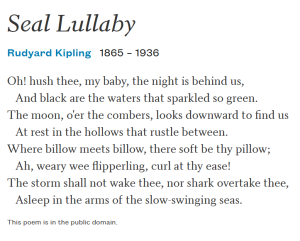
Today’s piece is based on a poem much older than Frost’s. Rudyard Kipling published Seal Lullaby in 1893, and included it as part of The Jungle Book in 1894. All that’s added to the original poem are overlapping “ooohs.”


National Poetry Month… Sings

Many of us might not have thought about National Poetry Month in… ever, since it was established by the Academy of American Poets in 1996, and most of us were out of grade school by then, so neither forced to read, listen to, nor write poetry. Many of us couldn’t otherwise say we’ve ever “celebrated” poetry except unintentionally. However, as musicians, we might be wise to care a bit more about poetry… simply because poetry and song go hand in hand.

The famous New Year’s song, Auld Lang Syne was first a folk song heard by the poet Robert Burns in the 18th century, and included in a collection of his poems, to which he added his own words. It was eventually turned back into a song and set to music in the 19th century. We know that hundreds of secular songs have lyrics cribbed from poetry, including Sheryl Crow’s Grammy-awarded 90’s earworm, “All I Wanna Do,” which came from a poem by Wyn Cooper titled, “Fun,” a poem he tried and failed to have widely known… until Sheryl Crow’s people ran across his poetry chapbook in a used bookstore.

The connection between hymns and poetry is even more interesting. Hymn #209 in the Presbyterian hymnal, My Song Is Love Unknown, written in 1664 by Puritan minister Samuel Crossman, came to him after he was kicked out of the Church of England during one of that denomination’s many bitter theological battles. It was set to music years later in 1925, rescuing it from obscurity. What a Friend We Have in Jesus was a poem written to Joseph M. Scriven’s mother in 1855, to comfort her after a death of a loved-one. In 1872, the poem, “The Brewing of Soma by Quaker poet John Greenleaf Whittier was published in The Atlantic. Holding forth on the danger of religious ritual to separate the faithful from God, the poem’s final six stanzas are not quite so thunderous, and became the well-loved and reflective Dear Lord and Father of Mankind in 1884.

All of this poetic history behind the songs we enjoy reminds a singer of the importance of lyrics. It’s easy to get stuck into worrying about notation, or the complexity of a harmony line (or realizing you’ve never seen the hymn in your life and feeling mildly panicked at having to sight-read quickly of a Sunday morning). But as we wade through the notes, let’s not forget to truly read the words, looking at the phrasing beyond where the system divides the line. Reading hymn lyrics in this way just might help us to better understand what we’re saying – and hopefully deepen our experience of singing as an avenue of worship. 🎶