A Clear Blue Morning

“I’m kind of addicted to the feeling of giving, knowing that I’m doing something good for someone else.” – Dolly Parton, 2021 People Magazine
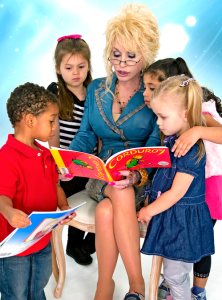
By now you’ll have heard that the governor signed bill SB 931 into law, making September 25th – 9-2-5, like the song “9-to-5” – officially Dolly Day in honor of the late singer and philanthropist Dolly Parton. In advance of the celebration in Union Square in San Francisco, fans are anticipating it as a costume holiday, breaking out the fringe and the falsies, the giant rhinestones, and the cowboy boots. While Dolly did indeed give us a surfeit of glitter and glam, she also gave her heart to her faith, and her money and her time to low income kids and families in the form of books and stories and heartful, hopeful music that lifted up those who listened. In addition to donning your platinum wig on Dolly Day this year, consider volunteering for the play cousins/niblings/grandchildren in your life. Donate a children’s book to a Little Free Library (psst! There’s one at Sherry’s house!) or to your local Friends of the Library bookstore. Clear out your old, gently used musical instruments and donate them to the East Bay Center for the Performing Arts, the Bay Area Girls Rock Camp, or the East Bay Depot for Creative Reuse, which supports teachers. A donation to Minding Music, a local nonprofit program that helps children from low-income families or kids with developmental issues get instruments and take music lessons might be timely as well.

Books and music can be a light in a dark and lonely world to a kid – so, on behalf of the smallfolk whose circumstances have them walking in shadow, arise and shine. Dolly Day or any day is a good day to be kind, and to help bring on the light of a clear, blue morning.

Misheard & Mondegreened

The ongoing sermon series on the misquoted words of Jesus brings to mind Mondegreens, those misheard lyrics of a song or poem that we say or sing with confidence.

The term was coined by Sylvia Wright in an article called ‘The Death of Lady Mondegreen’ (Harper’s, November 1954), where Wright reminisced on mishearing the words to the 17th century ballad, ‘The Bonnie Earl o’ Moray:’ “They hae slain the Earl o’ Moray, and Lady Mondegreen…” A young Sylvia thought the song described a double-murder when the slightly Scots-flavored words merely (!) described the sad aftermath of a duel, as they dispatched the Earl of Moray and laid him on the green… As in, a green piece of land, more prosaically termed a lawn.

For those of us who sang “round young Virgin Mother and Child” in Silent Night instead of “round ‘yon Virgin, or worried that there was a “bomb in Gilead,” rather than there being A Balm, we know part of the issue is homonyms, and another part lies with some archaic King James Version wording reproduced in some hymns. However, for listeners with a more solid vocabulary, the actual issue is that sometimes we singers just don’t enunciate clearly…! In the famous words of composer Jules Styne, “A song without words is just a piece of music.” Our job as choristers is to breathe life into song, allowing mere pieces of music to become so much more, to the glory of God.

So, as we hang out in our “deer-pants” being led beside “distilled waters,” when we’re done “Bringing in the Sheets,” may we keep a smile on our faces – and a sincere prayer in our hearts that the Divine allows our listeners to hear the right words at the right time from our music – even if they’re not quite the words on the page.

My Lord… What Morning…?


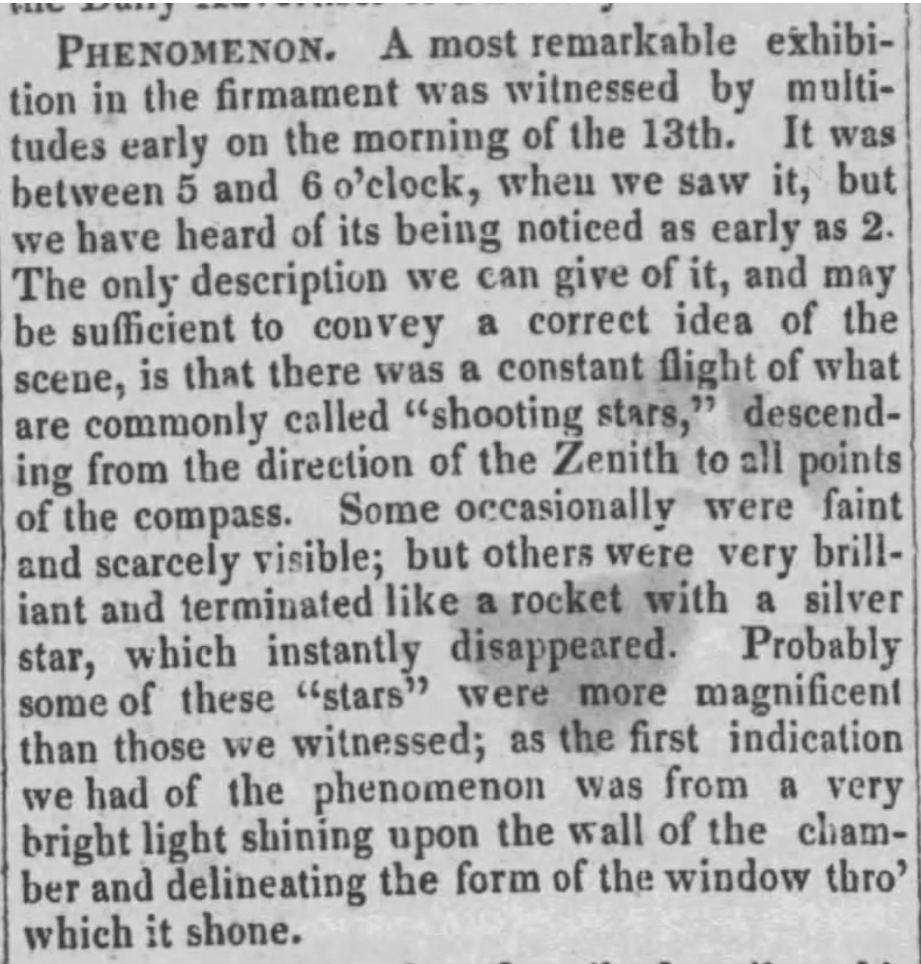
The Vermont Telegraph, 21st November, 1833.

For those of us who might ask, “What morning? When?” upon considering “when the stars begin to fall,” you are now informed: it was a very real morning and very real showers of stars – or, specifically, meteors – in 1833.

Residents of the stately antebellum mansions weren’t the first to see the stars falling on Alabama and the rest of the South that night – the first were the African enslaved living, as many did, outdoors, or in small shacks which were not light secure. As they woke to the glory, the word was passed from the field settlements to shacks and cabins and to the great houses. In Alabama, the Florence Gazette reported there were: “thousands of luminous bodies shooting across the firmament in every direction. There was little wind and not a trace of clouds, and the meteors succeeded each other in quick succession.”

While many believed the phenomenon to be only seen in the southern U.S., it was merely the best viewing there. History records the account of Victorian astronomy buff Agnes Clerke of Boston, who wrote of an attempt to count the meteors “…Their numbers … were quite beyond counting; but as it waned, a reckoning was attempted, from which it was computed, on the basis of that much-diminished rate, that 240,000 must have been visible during the nine hours they continued to fall.”

An enslaved child in Maury County, Tennessee, Amanda Young, wakened in her cot to the sound of screaming. Young, who was born around 1862, shared her story through her great-granddaughter, Angela Walton-Raji, who recorded an elderly cousin’s verbal recital of their ancestor’s passed down history in 2010. Walton-Raji’s recounts Young’s words, “Somebody in the quarters started yellin’ in the middle of the night to come out and to look up at the sky. We went outside and there they was a-fallin’ everywhere!

“Big stars coming down real close to the ground and just before they hit the ground they would burn up! We was all scared. Some o’ the folks was screamin’, and some was prayin’. We all made so much noise, the white folks came out to see what was happenin’. They looked up and then they got scared, too. But then the white folks started callin’ all the slaves together, and for no reason, they started tellin’ some of the slaves who their mothers and fathers was, and who they’d been sold to and where. The old folks was so glad to hear where their people went. They made sure we all knew what happened … you see, they thought it was Judgement Day.”


Themes of resurrection, redemption and judgment are present even in the earliest lyrics of this anonymously composed African American ‘spiritual song,’ which first appears in A Collection of Spiritual Songs and Hymns Selected from Various Authors (Philadelphia, 1801), by Richard Allen (1760–1831). Reverend Allen was a Philadelphia minister who collected the newly composed music of Black congregations who were, through worship services, composing and shaping what African American spirituals came to be. The imagery of trumpets sounding, “nations underground” rising, restored, Christians singing, and shouts of wonder reflects the cacophony of that historic Leonid meteor shower in November – and reminded them to order their affairs in hope of meeting another tumultuous day, when the Morningstar will rise, and all other stars fall in worship.

See you there.


Ashcraft, Jenny. “November 12-13, 1833: The Night the Stars Fell.” FishWrap: The official blog of Newspapers.com, November 7, 2022. https://blog.newspapers.com/november-12-13-1833-the-night-the-stars-fell/.
O’Keefe, Donal. “‘They Thought It Was Judgment Day’: The Night the Stars Fell on the US South.” The Irish Times, November 11, 2019. https://www.irishtimes.com/culture/they-thought-it-was-judgment-day-the-night-the-stars-fell-on-the-us-south-1.4075652.


Summer Scrapbook


Happy Summer from the Jones’, who sent along this snap to let us all know that Kateri’s recovering from her knee surgery really, really fast… (Not really! But even good patients get tired of wheelchairs.) Meanwhile, Mr. Jones sent along a shot of Wildcat Manor, an historical property that’s part of Hunn Nature Park in Kent County, Delaware. Wildcat Manor was the home of the Hunn family, who in 1779 became Quakers and freed the enslaved people on their property. Becoming staunch abolitionists, they set about the work of repair with John Hunn becoming the self-named Chief Engineer of the Delaware Underground Railroad in the mid 19th century. Wildcat Manor is part of the famous Harriet Tubman Byway – and Mr. Jones, whose family tree includes the Hunn family, enjoyed an extended family reunion there on the nation’s 250th birthday. We knew he was from good stock!

Be well, stay hydrated 🫗 and we’ll see you in August!

The Water is Wide…


Happy June, Friends!

It’s time for another ooold hymn! THERE’S A WIDENESS IN GOD’S MERCY comes from a thirteen-stanza poem written by Anglican-turned-Catholic priest, Frederick William Farber, whose aim was to encourage more hymn singing in his church. This has been a widely used hymn, and as with most hymns, denominations pick and choose from the plethora of verses and tunes, but most include the fourth verse as the first verse, and some version of the eighth stanza as their verse three:

There’s a Wideness in God’s Mercy

by Fred­er­ick W. Fa­ber, 1854

There’s a wideness in God’s mercy,
Like the wideness of the sea;
There’s a kindness in His justice,
Which is more than liberty.
There is welcome for the sinner,
And more graces for the good;
There is mercy with the Savior;
There is healing in His blood.

…

For the love of God is broader
Than the measure of our mind;
And the heart of the Eternal
Is most wonderfully kind.
If our love were but more simple,
We should take Him at His word;
And our lives would be all sunshine
In the sweetness of our Lord.

…however, as far as I know, only the Mennonite hymnal includes the ninth verse, which is perfect for this month with so many celebrations of the many facets of love and freedom:

But we make His love too narrow
By false limits of our own,
And we magnify His strictness
with a zeal He will not own.

It’s a little hard to believe that was written in 1854, isn’t it? And yet, olden days doesn’t mean ignorant days. God’s people have ever been leaning in to hear that still, small voice, and Jesus confirmed in person that love has always been on God’s mind.

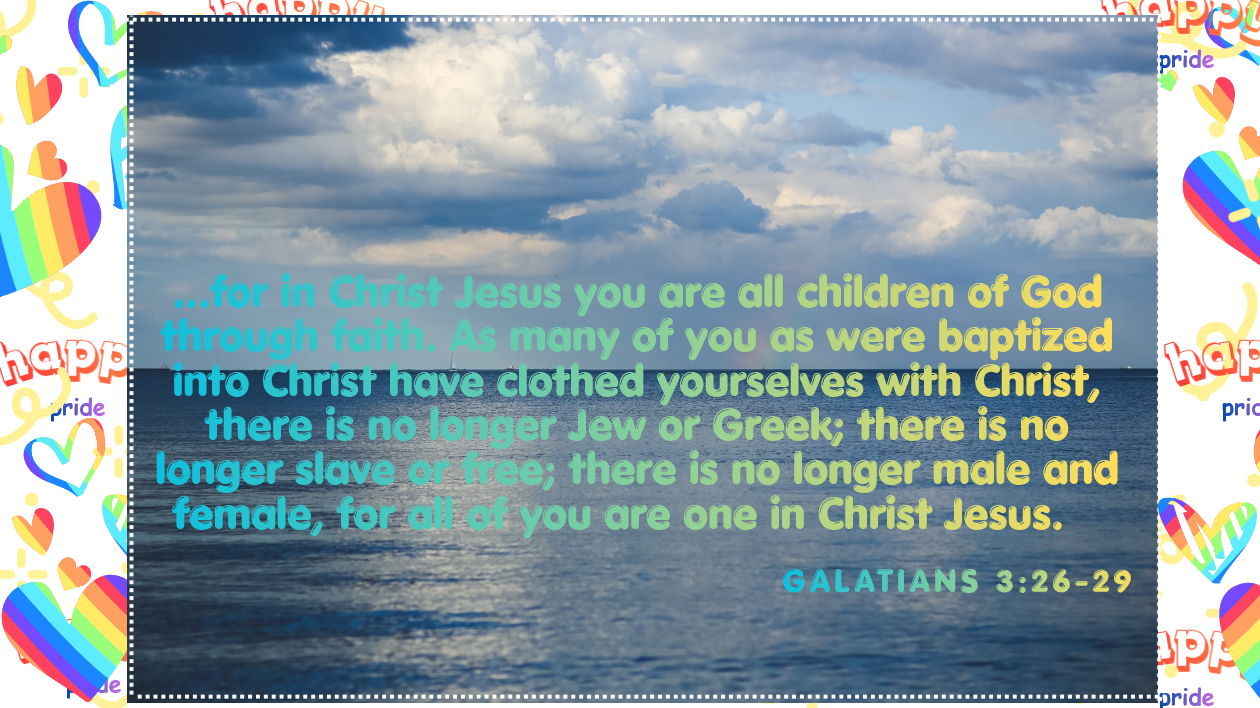
As we celebrate this month the reality of LGBTQIA people as beloved children of God and not pieces on the political chess board, as we celebrate marriages and fathering and the solstice and the long summer days, may we also rejoice in the love of God, a tide that rises to where we walk, so we can all get our feet wet in that wide, warm sea. Happy June.

Be Thou My Vision meets Be My Eyes 😍

“Rop tú mo bhoile,” the first line of “Be thou my vision,” in its native Irish Gaelic, is one of the oldest poems-turned-hymns still sung. Its historical provenance is rumored to be from between the 6th and 8th centuries, and is linked to a man, some say Patrick of Ireland, who burned a fire on Slane Hill to celebrate Easter, in defiance of a pagan King’s edict (This is why the folk tune used for the hymn is in some hymnals called “Slane.”) The poem was brought from obscurity by Mary Byrne in the early 1900’s, and was published in 1919 in Gaelic hymnals. Later, its sixteen (!) couplets were translated into modern English by Eleanor Hull, who took the lengthier poem down to twelve couplets, forming the four-line verses we know today. It is a hymn almost as familiar as “Amazing Grace” worldwide, and the request for a Divine opening to the singer’s eyes is universal. We all need – desperately at times – to see what we lack, what we have, and what matters most in this world more clearly.

An app that allows users to lend their eyes to the visually impaired broadens the ideas behind this beautiful hymn into an everyday reality. According to the World Health Organization, globally at least 2.2 billion individuals have a near or distance visual impairment, and at least 83.5 million are disabled by means of cataracts. In developing nations or in individuals for whom healthcare or funds to access it are limited, this causes a serious issue. Be My Eyes is a free app which has begun to change that. Imagine making a phone call to a stranger who has signed up specifically to be someone’s eyes that hour. You dropped your wedding ring on the floor. You need to see if your hibiscus has aphids. You can’t decipher the total on a hand-written receipt, or discern the contents of a deep shelf in a dim closet. Myriad are the things that are easier to see with a bit of help.

From the website, “In 2015, the Be My Eyes app was launched and, within 24 hours, 10,000 volunteers had signed up. Today, millions of volunteers support users in over 180 languages – proving that a little help goes a long way.” What a gift – both the hymn, and the app, and the chance to not only be someone’s vision, but to extend the reach of the Divine. This is your reminder that not everyone can do everything, but anyone can do something. Meanwhile, here’s to the hope that soon we will all see with unclouded eyes the glory of the Divine – both in the actions and in the faces of our community, both here and around the world.