If you wonder what brought Conrad Susa to arrange a Spanish-language version of Benjamin Britten’s Lessons & Carols, wonder no further. If you’re not in a hurry, this whole video is a nice reminiscence on the composer, but I’ve started closer to where it might be more relevant to FPCL. Mr. Susa’s playful nature is reflected in the music and hopefully can inform how we sing it:
 fpclchoircom
Misheard & Mondegreened
The ongoing sermon series on the misquoted words of Jesus brings to mind Mondegreens, those misheard lyrics of a song or poem that we say or sing with confidence.
The term was coined by Sylvia Wright in an article called ‘The Death of Lady Mondegreen’ (Harper’s, November 1954), where Wright reminisced on mishearing the words to the 17th century ballad, ‘The Bonnie Earl o’ Moray:’ “They hae slain the Earl o’ Moray, and Lady Mondegreen…” A young Sylvia thought the song described a double-murder when the slightly Scots-flavored words merely (!) described the sad aftermath of a duel, as they dispatched the Earl of Moray and laid him on the green… As in, a green piece of land, more prosaically termed a lawn.
For those of us who sang “round young Virgin Mother and Child” in Silent Night instead of “round ‘yon Virgin, or worried that there was a “bomb in Gilead,” rather than there being A Balm, we know part of the issue is homonyms, and another part lies with some archaic King James Version wording reproduced in some hymns. However, for listeners with a more solid vocabulary, the actual issue is that sometimes we singers just don’t enunciate clearly…! In the famous words of composer Jules Styne, “A song without words is just a piece of music.” Our job as choristers is to breathe life into song, allowing mere pieces of music to become so much more, to the glory of God.
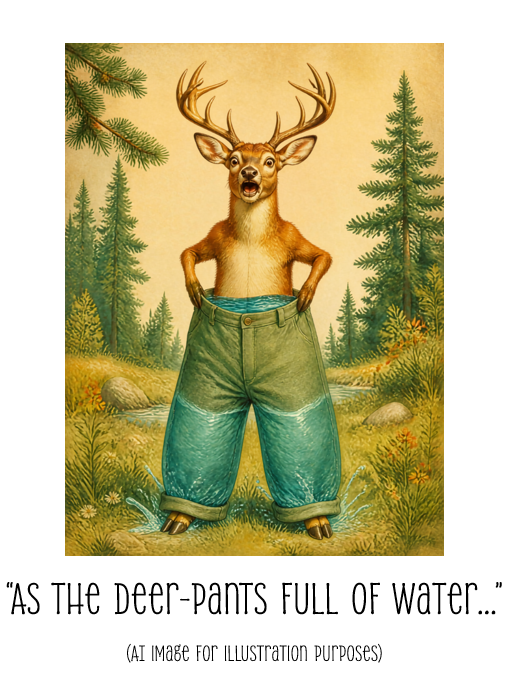
So, as we hang out in our “deer-pants” being led beside “distilled waters,” when we’re done “Bringing in the Sheets,” may we keep a smile on our faces – and a sincere prayer in our hearts that the Divine allows our listeners to hear the right words at the right time from our music – even if they’re not quite the words on the page.
Passing the Torch with Nursery Rhymes
As the Back to School train picks up speed (and commutes are, tragically, wholly bollixed once again), it’s a good moment to consider how we learn what we learn musically:
The advent of silent film in the early nineteen-twenties gave classical music a new outlet, as dramatic piano chords or full orchestras gave moving pictures further dramatic scope. When Walt Disney set Steamboat Willie to music in 1928, one of the first cartoons to have synchronized sound, music and film people got a lot of ideas. People who grew up in the early 20th century grew up with kids’ shows and cartoons set to classical music – from The Little Rascals in black and white to the technicolor resplendence of the Warner Brothers’ operatic interpretations. Music theory, including reading and comprehension of notes and Italian score notation, was sprinkled into cartoons as bits of common knowledge. It was certainly more common then than it is now.
But… common knowledge becomes uncommon as trends shift. Most people born in the late 20th and 21st century are largely unfamiliar with classical music as part of the common fabric of society. Even things like sung nursery rhymes moved aside to make way for newly composed and more educationally focused tunes (shout out to the heavy lifting done by educational public television, from Sesame Street and Mr. Rogers to School House Rock). Today, however, the pendulum is swinging back in the direction of early music education. 90’s folk icon Natalie Merchant spent time as artist-in-residence at a preschool year ago and has recently created a program designed to expose preschool and elementary aged kids to orchestral instruments, meaning in lyrics, and the absurdist imagery of nursery rhymes. Cabinet of Wonders is free a digital album comprised of seventeen songs and accompanying videos created in partnership with the Chicago Symphony Orchestra and the Chicago Children’s Theater as a free resource for schools to introduce kids to different styles of music. The accompanying website includes free sheet music and teacher’s guides – also created by Merchant (as were the costumes for musicians and performers for every video.)
While we are not exactly the target audience for cartoons and nursery rhymes, these are shared as a testament to the determination of musicians and educators who are passing the torch to continue to enlighten the world. As we figure out how best to do that ourselves, let’s keep singing. 🎶
A Little Vocalizing
Many younger elementary students experience what’s called the “summer slide,” where the first weeks back at school, academic concepts like sounding things out, writing a complete sentence or remembering long division are somewhat of a mystery – not to mention sitting quietly and remembering how to whisper. Lest we, as a choir, experience our own summer slide, here’s a little warm-up so you can keep yourself ready for what’s ahead – an oldie-but-goodie that is simple, catchy, and fun. Happy Week!
Summer Scrapbook

Happy Summer from the Jones’, who sent along this snap to let us all know that Kateri’s recovering from her knee surgery really, really fast… (Not really! But even good patients get tired of wheelchairs.) Meanwhile, Mr. Jones sent along a shot of Wildcat Manor, an historical property that’s part of Hunn Nature Park in Kent County, Delaware. Wildcat Manor was the home of the Hunn family, who in 1779 became Quakers and freed the enslaved people on their property. Becoming staunch abolitionists, they set about the work of repair with John Hunn becoming the self-named Chief Engineer of the Delaware Underground Railroad in the mid 19th century. Wildcat Manor is part of the famous Harriet Tubman Byway – and Mr. Jones, whose family tree includes the Hunn family, enjoyed an extended family reunion there on the nation’s 250th birthday. We knew he was from good stock!
Be well, stay hydrated 🫗 and we’ll see you in August!
Sing A Song of …Groceries…?

Most people in the United States and elsewhere grow up with music as a learning tool. We sing our ABC’s and learn the C Major scale singing Do-Re-Mi. Untold numbers of people recall vaguely how a bill gets to Congress or the function of a conjunction all because of Schoolhouse Rock, a musical education series (with some truly egregious earworms) first airing from 1976 to 1985 between Saturday morning cartoons on ABC. While learning things with a catchy song featured largely in our early lives, most adults abandon musical learning as they age – which is a shame because the tools that first taught us still work.
Dr. Daniel L. Bowling, Director of the Music, Brain, and Health Lab at Stanford School of Medicine, describes music as a time machine, allowing the parts of our brains that process sound to synchronize with the parts that process emotions and memory. Music goes from being the soundtrack of our external memories to being a way our internal stores meaningful, emotional connections. This is why doctors in Bangalore began working with music as post brain injury therapy, teaching stroke survivors to tap beats, speak in rhythm and then encouraging them to sing words into phrases and sentences. This isn’t just listening to music, though listening to songs does have its own well-researched and documented effects, especially for people living with dementia. No, this is singing – participating in a whole-brain way using rhythm and meter, lyrics and melody. The things that we sing, we remember.
If you want to remember a short grocery list without paper? Sing it. If you need to remember the directions somewhere? Set your freeway exits and turns to a simple tune like Twinkle, Twinkle Little Star. If you have a verse from Psalms or Isaiah which brings your heart comfort during the chaos and noise of a rough patch in your life, set it to the tune of a favorite and familiar hymn. The things that we sing, we remember. Music can move beyond merely being the soundtrack of our lives to being a vault – holding the song of our souls, and the meditations of our hearts.
More on this topic from Yale University.
eine kleine …Nachmittagmusik?!
“…in summer, the song sings itself.”
It’s not exactly a little night music, but now that you’ve got a that post-solstice light extending your later afternoon/early evenings, you could make time for the Golden Gate International Choral Festival, July 13-18. The theme of annual international festival, sponsored by the Piedmont East Bay Children’s Choir is “Sing the World.” The choral festival begins with a 4PM kick-off concert Monday in Walnut Creek, continues with a series of “spotlight concerts” from individual local and international choirs throughout the week in Oakland, Berkeley, and San Francisco, and then closes with another mass concert featuring singers, dancers, and international costume at the glitzy white LDS Interstake Center, aka “Temple Hill,” in Oakland.

Hearing children’s choirs is generally wildly entertaining to begin with, but dragging along kids and grandkids helps to ensure the future of choral music. After all, we have to get the next crop of singers from somewhere!
Meanwhile, if you’re missing your usual Thursday night music, here’s a little something with familiar voices to keep you company.
June1️⃣9️⃣th …Juneteenth
The long-held myth goes that on June 19, 1865, Union general Gordon Granger stood on the balcony of Ashton Villa in Galveston, Texas, and read the order that announced the end of slavery. Though no contemporaneous evidence exists to specifically support the claim, the story of General Granger reading from the balcony embedded itself into local folklore. On this day each year, as part of Galveston’s Juneteenth program, a reenactor from the Sons of Union Veterans reads the proclamation at Ashton Villa while an audience looks on. It is an annual moment that has taken a myth and turned it into tradition.
– from the book, How the Word Is Passed, by Clint Smith (as printed in The Paris Review). Copyright © 2021, Little, Brown and Company, New York, NY.
Most Americans outside of Texas did not learn this history in school, and many more only first heard of it when became an official U.S. federal holiday on June 17, 2021, when Joe Biden signed the Juneteenth National Independence Day Act into law. Some people don’t understand why this is a holiday at all, much less a federal one, but in the words of Fannie Lou Hamer, the Civil Rights figure who was fired from her job in 1962 after attempting to register to vote, “Nobody’s free until everybody’s free.” This holiday is a reminder not just in historical terms but in present terms as well – liberation for some is meaningless without “liberty and justice for all.” Restated in Christian terms, may Juneteenth be a reminder that every individual in all of humanity is made in the image of God, designed to flourish, and extended a holy welcome to life and joy in God.
