National Poetry Month… Sings
Many of us might not have thought about National Poetry Month in… ever, since it was established by the Academy of American Poets in 1996, and most of us were out of grade school by then, so neither forced to read, listen to, nor write poetry. Many of us couldn’t otherwise say we’ve ever “celebrated” poetry except unintentionally. However, as musicians, we might be wise to care a bit more about poetry… simply because poetry and song go hand in hand.
The famous New Year’s song, Auld Lang Syne was first a folk song heard by the poet Robert Burns in the 18th century, and included in a collection of his poems, to which he added his own words. It was eventually turned back into a song and set to music in the 19th century. We know that hundreds of secular songs have lyrics cribbed from poetry, including Sheryl Crow’s Grammy-awarded 90’s earworm, “All I Wanna Do,” which came from a poem by Wyn Cooper titled, “Fun,” a poem he tried and failed to have widely known… until Sheryl Crow’s people ran across his poetry chapbook in a used bookstore.
The connection between hymns and poetry is even more interesting. Hymn #209 in the Presbyterian hymnal, My Song Is Love Unknown, written in 1664 by Puritan minister Samuel Crossman, came to him after he was kicked out of the Church of England during one of that denomination’s many bitter theological battles. It was set to music years later in 1925, rescuing it from obscurity. What a Friend We Have in Jesus was a poem written to Joseph M. Scriven’s mother in 1855, to comfort her after a death of a loved-one. In 1872, the poem, “The Brewing of Soma by Quaker poet John Greenleaf Whittier was published in The Atlantic. Holding forth on the danger of religious ritual to separate the faithful from God, the poem’s final six stanzas are not quite so thunderous, and became the well-loved and reflective Dear Lord and Father of Mankind in 1884.
All of this poetic history behind the songs we enjoy reminds a singer of the importance of lyrics. It’s easy to get stuck into worrying about notation, or the complexity of a harmony line (or realizing you’ve never seen the hymn in your life and feeling mildly panicked at having to sight-read quickly of a Sunday morning). But as we wade through the notes, let’s not forget to truly read the words, looking at the phrasing beyond where the system divides the line. Reading hymn lyrics in this way just might help us to better understand what we’re saying – and hopefully deepen our experience of singing as an avenue of worship. 🎶
Courage Stretching ‘Round the World: “Hold On”
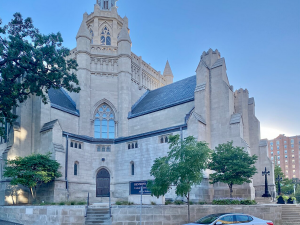
The events of January, 2026 were the crucible from which formed the Hennepin Avenue United Methodist Church’s Singing Resistance, a Minneapolis-based, grassroots movement using song to protest the illegal federal agent activity in that state and throughout the nation. Time after time in our nation’s history, protest singing has been a tool for organizers, as a form of embodied protest – from “Yankee Doodle,” sung in protest against British imperialism in the 1700’s to “The Battle Hymn of the Republic,” sung by marching suffragists and labor organizers, to songs like “We Shall Not Be Moved,” and “We Shall Overcome” sung through the years by protestors for civil rights in the early 1900’s and beyond. Every major sea change in American politics and society has come with a soundtrack of people singing together.
However, in the past several decades group singing has waned outside of religious circles. Even in some religious spaces, singing has largely become a competitive reality TV type of thing where “the best” is elevated and ‘the rest’ are meant to sit in silence. In this atmosphere, the commonly sung American folk song had all but vanished. Dorian Lynskey, author of “33 Revolutions Per Minute: A History of Protest Songs,” theorized that American individualism in music also has its role in this musical shift. Older songs used the word “we.” “We shall overcome.” Or, “All we are saying is give peace a chance.” The spirit of “we” as found in community and cooperation is largely absent in modern pop music.
…until recently. Now the old protest songs are being taught to new voices. Now we’re reaching across aisles, across cultures and preferences, trying to anchor ourselves, our country, and each other.
A song heard at almost every singing protest, many of you are already familiar with Heidi Wilson’s “Hold On.” The words are simple, the tune adapting easily to harmony, and it has reverberated – from the U.S. to Cornwall to Wales and Ireland to Australia and beyond. A new generation of singers is carrying this song with them, and like a stone dropped into a pond, its message of quiet, almost prayerful endurance is rippling outward.
And when you learn from writer and composer Heidi Wilson the impetus behind the song she wrote in 2020, you’ll understand what a gift it truly is.
“Weeping may endure for a night, but joy comes in the morning.” Psalms 30:5b
Hold On
Hold on, hold on
My dear ones, here comes the dawn
– Heidi Wilson,
Plainfield, VT 2020
(Sheet music free at the link above. Please compensate and support the musician if you can.)
“Music mends minds” at the Kay Dolby Brain Health Center, San Francisco
Though sometimes when The Director pulls a song we’ve not done in a few years, we feel like we’re totally out to sea, never doubt the power of music to stay in our memories – somewhere. KQED’s recent report on the power of music to support people living with Alzheimer’s presents a powerful argument for staying involved with music for your whole life. Details about the program, including where to RSVP if you’re interested in showing up are here.
😖This orchestra is perhaps THE WORST… Which is great! 🥳

Well, we’re told to make a “joyful noise,” but the Creator didn’t mention the emphasis being particularly on the noise part… A recent story by KPBS (a public media station based in San Diego, California (operated by San Diego State University in cooperation with NPR and PBS) shared footage of the worst orchestra you’ve probably never heard of. The Coronado Terrible Orchestra is demonstrably bad – and they’re really okay with that. Their director, Cassie O’Hanlon, wearing a black T-shirt bearing the words “Be So Kind To Yourself Right Now,” explained that the idea for the group came first from The Really Terrible Orchestra of Scotland, and another terrible group in the last town where she’d lived.
“So I was inspired by the same concept ultimately in Fort Wayne, Indiana, where I moved here from. There was a terrible orchestra. So when I moved out here, I kind of started noticing, at least south, there’s just not as big of a music community. So I just thought, why not try?“
We love to watch the Littles at Christmas during the pageant or processing through the sanctuary with their palm branches and hosannas. Little ones are celebrated for learning incompletely and performing badly all the time… but in our society, that’s a grace adults aren’t given. Can we make a space in our lives where the joy and connection – and not the perfection in music is what we’re about? While we don’t have to belong to a really terrible orchestra to make mistakes – we all do it every week – but as we learn, may we also keep patience and a sense of humor in the forefront of our hearts as we make our joyful noise together.
📖 FPCL Lenten Series: The Screwtape Letters by C.S. Lewis 📚

Greetings, Friends!
As Janet has let us know about Dr. Wilde’s upcoming sermon series on The Screwtape Letters, I wanted to be sure that you aware that you can not only buy this short book but listen to it – for free – as a YouTube audiobook. Well-known British actor and humorist John Cleese narrates it here in its entirety. The Trinity School of Stayton, Washington, presents it here, in thirty separate videos by chapter so you can sample it in little bites.
Happy Reading!📘
WELCOME!
Welcome to The Score!
 Here is where you’ll find news, resources, event info (festivals, retreats, competitions), and tips from the broader choral music world, as well as dates and details of the weekly choir practice at FPCL, information on future performances and rehearsal opportunities, social events, and more. This is a place where you can have your choir-related questions answered – first by searching a Frequently Asked Questions list, or by leaving a question for the site administrator or your director when information isn’t available. We plan to incorporate a community page where you can share music-related news, choir-specific suggestions for your director, as well as comments on what you appreciated and what we might consider doing differently. Eventually this will be a place where hopefully we can use the calendar to digitally track when choir members will be away, and a place to leave notes in case of unexpected illness.
Please note that this is not the place for general complaints about your fellow choir members or FPCL choir policies and procedures, political content of any kind, or forwarded jokes and humor, unless they come from the director.
This is an experiment, and intended to lessen the burden of individual communication on the part of the director. Please be patient as we iron out the inevitable wrinkles for all of us making use of a new system.
