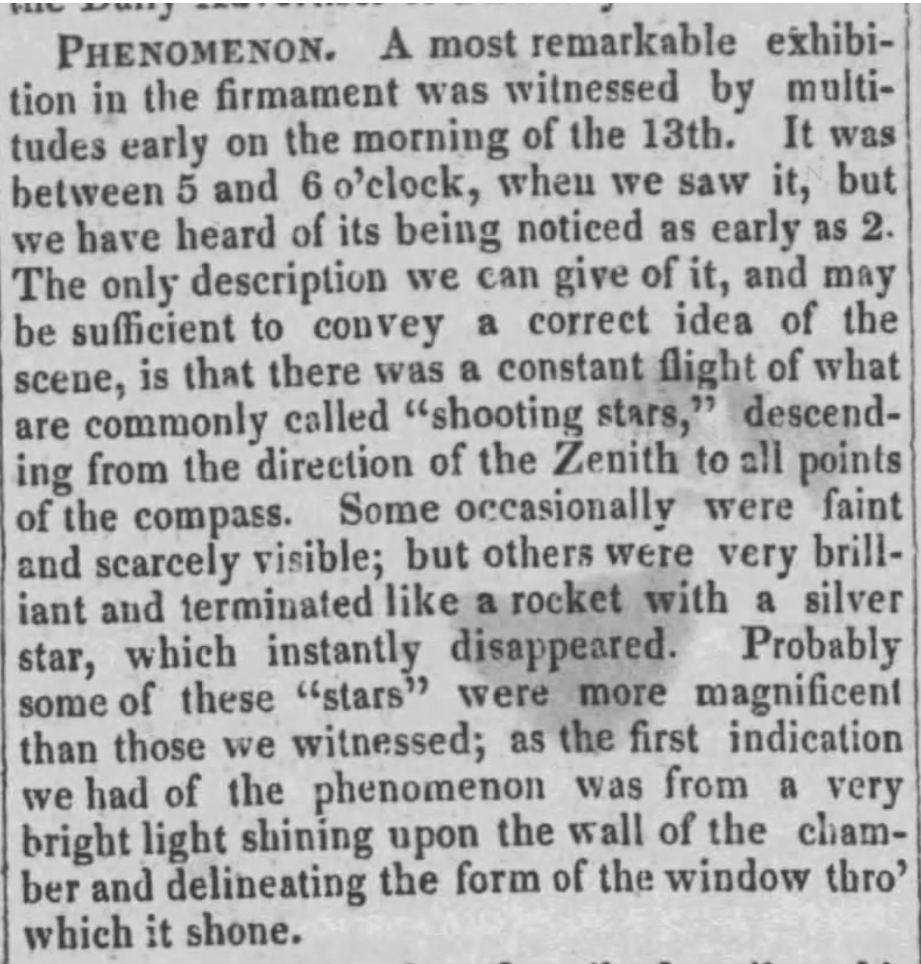
The Vermont Telegraph, 21st November, 1833.
For those of us who might ask, “What morning? When?” upon considering “when the stars begin to fall,” you are now informed: it was a very real morning and very real showers of stars – or, specifically, meteors – in 1833.
Residents of the stately antebellum mansions weren’t the first to see the stars falling on Alabama and the rest of the South that night – the first were the African enslaved living, as many did, outdoors, or in small shacks which were not light secure. As they woke to the glory, the word was passed from the field settlements to shacks and cabins and to the great houses. In Alabama, the Florence Gazette reported there were: “thousands of luminous bodies shooting across the firmament in every direction. There was little wind and not a trace of clouds, and the meteors succeeded each other in quick succession.”
While many believed the phenomenon to be only seen in the southern U.S., it was merely the best viewing there. History records the account of Victorian astronomy buff Agnes Clerke of Boston, who wrote of an attempt to count the meteors “…Their numbers … were quite beyond counting; but as it waned, a reckoning was attempted, from which it was computed, on the basis of that much-diminished rate, that 240,000 must have been visible during the nine hours they continued to fall.”
An enslaved child in Maury County, Tennessee, Amanda Young, wakened in her cot to the sound of screaming. Young, who was born around 1862, shared her story through her great-granddaughter, Angela Walton-Raji, who recorded an elderly cousin’s verbal recital of their ancestor’s passed down history in 2010. Walton-Raji’s recounts Young’s words, “Somebody in the quarters started yellin’ in the middle of the night to come out and to look up at the sky. We went outside and there they was a-fallin’ everywhere!
“Big stars coming down real close to the ground and just before they hit the ground they would burn up! We was all scared. Some o’ the folks was screamin’, and some was prayin’. We all made so much noise, the white folks came out to see what was happenin’. They looked up and then they got scared, too. But then the white folks started callin’ all the slaves together, and for no reason, they started tellin’ some of the slaves who their mothers and fathers was, and who they’d been sold to and where. The old folks was so glad to hear where their people went. They made sure we all knew what happened … you see, they thought it was Judgement Day.”
Themes of resurrection, redemption and judgment are present even in the earliest lyrics of this anonymously composed African American ‘spiritual song,’ which first appears in A Collection of Spiritual Songs and Hymns Selected from Various Authors (Philadelphia, 1801), by Richard Allen (1760–1831). Reverend Allen was a Philadelphia minister who collected the newly composed music of Black congregations who were, through worship services, composing and shaping what African American spirituals came to be. The imagery of trumpets sounding, “nations underground” rising, restored, Christians singing, and shouts of wonder reflects the cacophony of that historic Leonid meteor shower in November – and reminded them to order their affairs in hope of meeting another tumultuous day, when the Morningstar will rise, and all other stars fall in worship.
See you there.
Ashcraft, Jenny. “November 12-13, 1833: The Night the Stars Fell.” FishWrap: The official blog of Newspapers.com, November 7, 2022. https://blog.newspapers.com/november-12-13-1833-the-night-the-stars-fell/.
O’Keefe, Donal. “‘They Thought It Was Judgment Day’: The Night the Stars Fell on the US South.” The Irish Times, November 11, 2019. https://www.irishtimes.com/culture/they-thought-it-was-judgment-day-the-night-the-stars-fell-on-the-us-south-1.4075652.