Broadway in Your Living Room

If you can’t make it to New York this month, PBS’s Great Performances is sharing the full musical, “Suffs” on YouTube until July 31st! Celebrate midterms, reflect on the work of political protest that the suffragists did in the service of the 19th Amendment, and the work of equality which we still have before us, 250 years on, while enjoying this glorious historical musical by Tony award-winning singer, actress, and composer Shaina Taub.

“Keep Marching” is a wildly popular piece from the musical – and this video depicts its recording for the album in New York City. Listening to the lyrics (which are helpfully included in the full PBS performance), it’s clear how relevant they are to our current moment, and how carefully the composer worked to give both the singers and the audience the time and means to take in the meaning with repetition and building on the theme. The singers simply embody it and make it live. As the choir sings, watch how both they and the soloist create with their whole bodies – making unfortunate faces in the service of pronunciation, dropping their jaws and widening their mouths to increase their sound, shoulders dropping, bodies pulsing with their inhales and rhythmic pulses, and pencils in every hand, at the ready. They bring just so much energy to every note and phrase, opening themselves to unselfconsciously becoming the music. Their leaning into and understanding of the music is the gold standard for singers, and every composer’s goal – you can see Taub several times clutching her heart and tearing up, because it’s truly amazing.

Meanwhile, there’s much to do, friends. 🌻Keep marching.
The Water is Wide…


Happy June, Friends!

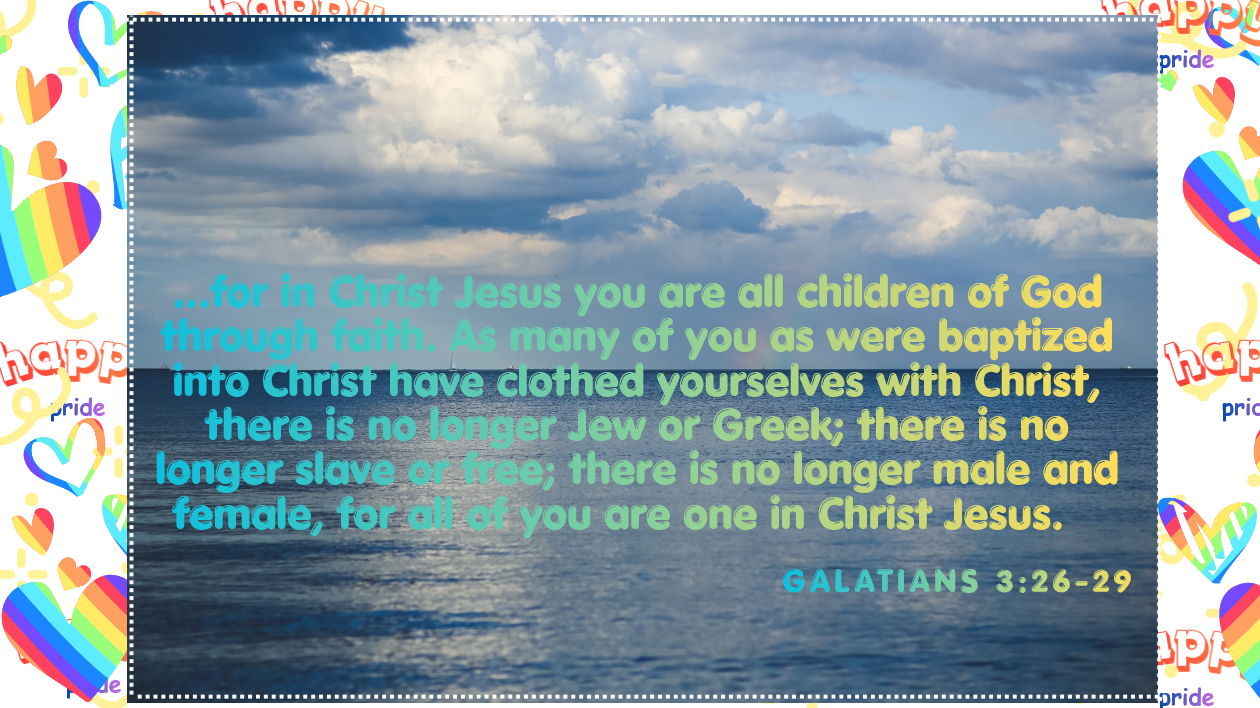
It’s time for another ooold hymn! THERE’S A WIDENESS IN GOD’S MERCY comes from a thirteen-stanza poem written by Anglican-turned-Catholic priest, Frederick William Farber, whose aim was to encourage more hymn singing in his church. This has been a widely used hymn, and as with most hymns, denominations pick and choose from the plethora of verses and tunes, but most include the fourth verse as the first verse, and some version of the eighth stanza as their verse three:

There’s a Wideness in God’s Mercy

by Fred­er­ick W. Fa­ber, 1854

There’s a wideness in God’s mercy,
Like the wideness of the sea;
There’s a kindness in His justice,
Which is more than liberty.
There is welcome for the sinner,
And more graces for the good;
There is mercy with the Savior;
There is healing in His blood.

…

For the love of God is broader
Than the measure of our mind;
And the heart of the Eternal
Is most wonderfully kind.
If our love were but more simple,
We should take Him at His word;
And our lives would be all sunshine
In the sweetness of our Lord.

…however, as far as I know, only the Mennonite hymnal includes the ninth verse, which is perfect for this month with so many celebrations of the many facets of love and freedom:

But we make His love too narrow
By false limits of our own,
And we magnify His strictness
with a zeal He will not own.

It’s a little hard to believe that was written in 1854, isn’t it? And yet, olden days doesn’t mean ignorant days. God’s people have ever been leaning in to hear that still, small voice, and Jesus confirmed in person that love has always been on God’s mind.

As we celebrate this month the reality of LGBTQIA people as beloved children of God and not pieces on the political chess board, as we celebrate marriages and fathering and the solstice and the long summer days, may we also rejoice in the love of God, a tide that rises to where we walk, so we can all get our feet wet in that wide, warm sea. Happy June.

{National Poetry Month: DIY}


National Poetry Month is over for another year, but poetry never quits. Here’s one last poem from Andrea Gibson, which might just be a song yet unborn. Perhaps this is the anthem for the living which you’ll create yourself.

Acceptance Speech after Setting the World Record in Goosebumps

Too much lives in a moment
to not feed it to the fire in the heart, slow.
A Missoula treehouse filled with candlelight:
          143 goosebumps.

The octopus documentary:
          54 goosebumps, multiplied by 8.

The biggest dog in the shelter
hiding behind a teacup chihuahua,
and the woman who came to adopt a cat
taking all three of them home:
          1,012 goosebumps.

There is no escaping the magic now.
Beauty caught me and never let me go.
And the thing about the world record
Is– if someone breaks it after me,
and they will break it after me,
I will love that so much
that without even trying,

                    I’ll break it again.

Courage Stretching ‘Round the World: “Hold On”

The events of January, 2026 were the crucible from which formed the Hennepin Avenue United Methodist Church’s Singing Resistance, a Minneapolis-based, grassroots movement using song to protest the illegal federal agent activity in that state and throughout the nation. Time after time in our nation’s history, protest singing has been a tool for organizers, as a form of embodied protest – from “Yankee Doodle,” sung in protest against British imperialism in the 1700’s to “The Battle Hymn of the Republic,” sung by marching suffragists and labor organizers, to songs like “We Shall Not Be Moved,” and “We Shall Overcome” sung through the years by protestors for civil rights in the early 1900’s and beyond. Every major sea change in American politics and society has come with a soundtrack of people singing together.

However, in the past several decades group singing has waned outside of religious circles. Even in some religious spaces, singing has largely become a competitive reality TV type of thing where “the best” is elevated and ‘the rest’ are meant to sit in silence. In this atmosphere, the commonly sung American folk song had all but vanished. Dorian Lynskey, author of “33 Revolutions Per Minute: A History of Protest Songs,” theorized that American individualism in music also has its role in this musical shift. Older songs used the word “we.” “We shall overcome.” Or, “All we are saying is give peace a chance.” The spirit of “we” as found in community and cooperation is largely absent in modern pop music.

…until recently. Now the old protest songs are being taught to new voices. Now we’re reaching across aisles, across cultures and preferences, trying to anchor ourselves, our country, and each other.

A song heard at almost every singing protest, many of you are already familiar with Heidi Wilson’s “Hold On.” The words are simple, the tune adapting easily to harmony, and it has reverberated – from the U.S. to Cornwall to Wales and Ireland to Australia and beyond. A new generation of singers is carrying this song with them, and like a stone dropped into a pond, its message of quiet, almost prayerful endurance is rippling outward.

And when you learn from writer and composer Heidi Wilson the impetus behind the song she wrote in 2020, you’ll understand what a gift it truly is.

“Weeping may endure for a night, but joy comes in the morning.” Psalms 30:5b

Hold On

Hold on, hold on

My dear ones, here comes the dawn

– Heidi Wilson,
Plainfield, VT 2020
(Sheet music free at the link above. Please compensate and support the musician if you can.)

“Music mends minds” at the Kay Dolby Brain Health Center, San Francisco

Though sometimes when The Director pulls a song we’ve not done in a few years, we feel like we’re totally out to sea, never doubt the power of music to stay in our memories – somewhere. KQED’s recent report on the power of music to support people living with Alzheimer’s presents a powerful argument for staying involved with music for your whole life. Details about the program, including where to RSVP if you’re interested in showing up are here.

😖This orchestra is perhaps THE WORST… Which is great! 🥳

Well, we’re told to make a “joyful noise,” but the Creator didn’t mention the emphasis being particularly on the noise part… A recent story by KPBS (a public media station based in San Diego, California (operated by San Diego State University in cooperation with NPR and PBS) shared footage of the worst orchestra you’ve probably never heard of. The Coronado Terrible Orchestra is demonstrably bad – and they’re really okay with that. Their director, Cassie O’Hanlon, wearing a black T-shirt bearing the words “Be So Kind To Yourself Right Now,” explained that the idea for the group came first from The Really Terrible Orchestra of Scotland, and another terrible group in the last town where she’d lived.

“So I was inspired by the same concept ultimately in Fort Wayne, Indiana, where I moved here from. There was a terrible orchestra. So when I moved out here, I kind of started noticing, at least south, there’s just not as big of a music community. So I just thought, why not try?“

We love to watch the Littles at Christmas during the pageant or processing through the sanctuary with their palm branches and hosannas. Little ones are celebrated for learning incompletely and performing badly all the time… but in our society, that’s a grace adults aren’t given. Can we make a space in our lives where the joy and connection – and not the perfection in music is what we’re about? While we don’t have to belong to a really terrible orchestra to make mistakes – we all do it every week – but as we learn, may we also keep patience and a sense of humor in the forefront of our hearts as we make our joyful noise together.

WELCOME!

Welcome to The Score!

Here is where you’ll find news, resources, event info (festivals, retreats, competitions), and tips from the broader choral music world, as well as dates and details of the weekly choir practice at FPCL, information on future performances and rehearsal opportunities, social events, and more. This is a place where you can have your choir-related questions answered – first by searching a Frequently Asked Questions list, or by leaving a question for the site administrator or your director when information isn’t available. We plan to incorporate a community page where you can share music-related news, choir-specific suggestions for your director, as well as comments on what you appreciated and what we might consider doing differently. Eventually this will be a place where hopefully we can use the calendar to digitally track when choir members will be away, and a place to leave notes in case of unexpected illness.

Please note that this is not the place for general complaints about your fellow choir members or FPCL choir policies and procedures, political content of any kind, or forwarded jokes and humor, unless they come from the director.

This is an experiment, and intended to lessen the burden of individual communication on the part of the director. Please be patient as we iron out the inevitable wrinkles for all of us making use of a new system.