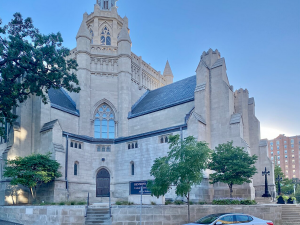
The events of January, 2026 were the crucible from which formed the Hennepin Avenue United Methodist Church’s Singing Resistance, a Minneapolis-based, grassroots movement using song to protest the illegal federal agent activity in that state and throughout the nation. Time after time in our nation’s history, protest singing has been a tool for organizers, as a form of embodied protest – from “Yankee Doodle,” sung in protest against British imperialism in the 1700’s to “The Battle Hymn of the Republic,” sung by marching suffragists and labor organizers, to songs like “We Shall Not Be Moved,” and “We Shall Overcome” sung through the years by protestors for civil rights in the early 1900’s and beyond. Every major sea change in American politics and society has come with a soundtrack of people singing together.
However, in the past several decades group singing has waned outside of religious circles. Even in some religious spaces, singing has largely become a competitive reality TV type of thing where “the best” is elevated and ‘the rest’ are meant to sit in silence. In this atmosphere, the commonly sung American folk song had all but vanished. Dorian Lynskey, author of “33 Revolutions Per Minute: A History of Protest Songs,” theorized that American individualism in music also has its role in this musical shift. Older songs used the word “we.” “We shall overcome.” Or, “All we are saying is give peace a chance.” The spirit of “we” as found in community and cooperation is largely absent in modern pop music.
…until recently. Now the old protest songs are being taught to new voices. Now we’re reaching across aisles, across cultures and preferences, trying to anchor ourselves, our country, and each other.
A song heard at almost every singing protest, many of you are already familiar with Heidi Wilson’s “Hold On.” The words are simple, the tune adapting easily to harmony, and it has reverberated – from the U.S. to Cornwall to Wales and Ireland to Australia and beyond. A new generation of singers is carrying this song with them, and like a stone dropped into a pond, its message of quiet, almost prayerful endurance is rippling outward.
And when you learn from writer and composer Heidi Wilson the impetus behind the song she wrote in 2020, you’ll understand what a gift it truly is.
“Weeping may endure for a night, but joy comes in the morning.” Psalms 30:5b
Hold On
Hold on, hold on
My dear ones, here comes the dawn
– Heidi Wilson,
Plainfield, VT 2020
(Sheet music free at the link above. Please compensate and support the musician if you can.)
